
A great digital audio workstation for the iPad with some experimental ways to make music
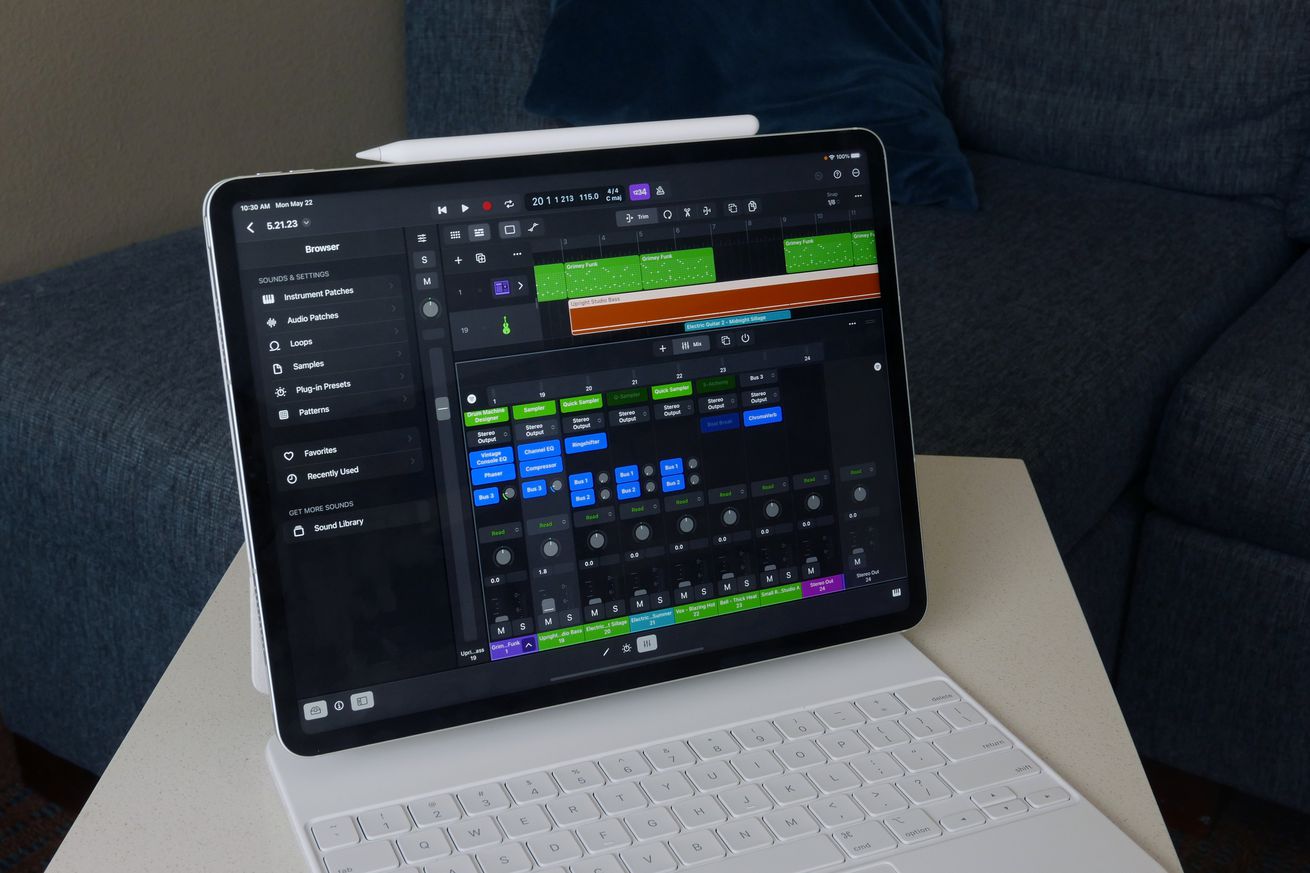
Over the past few days, I’ve been having a lot of fun composing riffs, beats, and rhythms using the new iPad version of Apple’s music production software Logic Pro. The subtly redesigned app translates the company’s pro-level audio app to a touchscreen interface really well, and thankfully, it does not dumb it down for a mobile screen.
Those who have used GarageBand on an iPad will be familiar with a touch interface for virtual instruments and recording, but with Logic Pro, you have a whole lot more things to adjust — more knobs, faders, automations, plug-ins, and samples. I’ve been using Logic Pro on a 12.9-inch iPad Pro, so I’m using the biggest touchscreen available for this app (and basically the size of a laptop). That being said, nothing really felt cramped or hard to navigate in this interface. Using it on my iPad mini might not be as fun, though.
The biggest change with adapting Logic Pro for the iPad is the way you interact with plug-ins, the play surfaces, and the redesigned browser. To accommodate the screen size, the plug-in window has simplified versions of each plug-in that Apple is calling “tiles.” There, you can tweak basic settings on compressors, EQ, reverb, etc., and then tap the tile to open up the full version of the plug-ins to refine settings. Quickly adjusting something like the threshold on a compressor, viewing the parametric EQ, or adjusting the wet / dry mix of a pitch shifter while still having the full view of the editor is really helpful and more efficient for this sort of setup.
Using multi-touch to play the neck of a bass, keys on the piano, or a drum pad is an obvious plus to using the iPad for producing music virtually, and that’s where a lot of the fun comes in. I made a funky beat sitting in the airport waiting for a flight, tooled around with mixing on the plane in the air, and landed a few hours later with something that I would seriously consider using for a professional project.
In Logic Pro for the iPad, finding instruments, samples, and audio loops is slightly different than how it’s laid out on the Mac, with instruments, loops, samples, presets, and patterns all in one place. At first, this was a little confusing figuring out which kind of sound will support which kind of track, but overall, it’s a lot easier to navigate when you want a certain type of instrument, genre, or sample. The browser allowed me to search for the right type of kick drum I want to add to my drum pad or preview a synth that would work best for my project, so overall, not many complaints there. If you want to add your own samples or audio files, you can drag those into a project from the Files app.
Apple has also added more samples and tools to this new version, including Sample Alchemy and Beat Breaker, which are some very fun experiment tools for manipulating sounds. I could probably spend a few hours just playing with Beat Breaker on a track and making wild new sounds chopping up a drum beat or sample.
Surprisingly, I did not feel the need for a keyboard with Logic Pro and used the Magic Keyboard to mostly prop up the iPad. There are still some things I prefer to use a keyboard for, of course, like pressing the spacebar to play, switching between the mixer, editor, and plug-in windows, or searching in the browser window, but like a lot of DAWs, Logic Pro’s interface is modeled after analog mixers, so adjusting a knob or a fader with your finger just makes more sense. (I’ve never met an engineer who likes to use a mouse to adjust a potentiometer knob.)
If you want to take advantage of both the touchscreen and a keyboard and mouse, Logic Pro for the iPad still recognizes some of the keyboard shortcuts from the Mac version, but not everything. This app really benefits from you using multi-touch. My reflex shortcut that I’ve ingrained in my head is Command-S for saving, but this does not seem to do anything on the iPad. (The projects do auto-save, but to rename or save as, I had to do in the file browser.)
Eventually, I started to prefer the precision of the Apple Pencil over my finger to fine-tune MIDI note placements or trimming clips. But like other Pencil-centric apps, it was a bit awkward going back to using multi-touch to zoom in and out of my timeline with the Pencil in my hand. The most useful Pencil feature is for drawing automation curves right on the screen rather than the slightly frustrating desktop way of clicking and dragging little dots over clips with a mouse.
/cdn.vox-cdn.com/uploads/chorus_asset/file/24675966/P1020073.jpg)
Photo by Andrew Marino / The Verge
I also found plugging the iPad in to a monitor was a pretty neat experience — sort of like using a Wacom tablet — drawing automatic curves or playing a virtual instrument while viewing the DAW on a bigger screen.
As for compatibility with the Mac version, the biggest thing you cannot do with the iPad version is load a lot of third-party plug-ins used in many desktop DAWs. The iPad version supports a bunch of Audio Unit plug-ins available in the App Store, but if you use any VST plug-ins or ones that are not in the App Store (such as the popular Waves options), they won’t carry in your project on the iPad. Those plug-ins will be missing. Your best bet is bouncing those effects down to a new audio track and saving before your transfer to the iPad. There are some other power user features that are missing in the iPad app, like viewing more MIDI data, adding project notes, and more customizable export settings. This did not really impact my workflow, especially if I am going to carry over the project to my desktop, but it might be an issue for some.
Another stumbling block is when I transferred an iPad project to the Mac, an audio sample from the library was not available on my desktop. So if you’re going back and forth between devices on one project, you’re going to have to think about what is compatible with what version. Apple says Logic Pro for Mac will have a compatibility update today to make it work with the iPad, including the ability to open tracks with non-editable versions of Beat Breaker or Sample Alchemy, but no word on when the full version of those plug-ins will come to the Mac version. However, if you do not have the sounds downloaded on your Mac that you have downloaded in the iPad version, Logic Pro will automatically download those sounds for you when opening the project on the Mac, and vice versa. And, of course, this is all great if you actually have a Mac to go and use some pro-level plug-ins — Logic Pro is only on Apple products. Exporting lets you AirDrop the file to another device, as well as the other apps in your share sheet.
What excites me the most about using Logic Pro for the iPad is just having a professional and reliable multitrack digital audio workstation on an iPad that I can easily transfer projects to my Mac. I was able to plug in a number of external audio interfaces into an iPad Pro, and Logic Pro recognized them quickly in the audio input / output settings. That’s where it really started to feel like a professional audio workstation.
And really, the ideal way to mix with Logic Pro for the iPad is with an external audio interface. There are not many iPads with a headphone jack anymore (Logic Pro is supported on iPads with an A12 chip and above, which includes the ninth-gen iPad, the lone remaining option with a 3.5mm jack), so you’re likely going to need some sort of adapter anyway to listen with headphones. Of course, you can try to use Bluetooth headphones, but that’s not ideal for music-making due to Bluetooth lag and syncing issues. Apple even warns you in the app when you pair wireless headphones that “You may notice a delay when playing Touch Instruments or playing back your song.” When I paired my Bose QC35 to my iPad to try to mix, it was unmanageable.
/cdn.vox-cdn.com/uploads/chorus_asset/file/24675958/P1020070.jpg)
Photo by Andrew Marino / The Verge
Apple offers Logic Pro for the iPad for $4.99 a month or $49 for a yearly subscription (with a month free), as opposed to the $199 perpetual license on the Mac. Though I am hesitant about subscription-based production software, five dollars a month is really a great price for a powerful tool like this, and you can unsubscribe when you’re not using it. I will most likely be paying for Logic Pro on and off on my iPad Mini when I want to do some multitrack recording or make some fun tracks when I’m traveling.
Five bucks a month is a very low bar to entry for anyone wanting to get into making music, so I’ll be looking out for the first album made entirely in this app. Logic Pro for the Mac has been used by artists and producers for years and has been the DAW of choice for artists like Lil Nas X, Billie Eilish, Taylor Swift, Ed Sheeran, and many more. Bringing this software to the iPad (along with Final Cut Pro) really shows off the strength and flexibility of the iPad more than any software I’ve seen so far.