
The new campaign centers around the fact that with people knowingly and unknowingly sharing more and more about themselves online, protection of private health information has become an increasingly important issue. With Apple's built-in privacy protections across its devices and services, the company is seeking to reassure users that their health data remains secure within Apple's ecosystem.

Apple cites four pillars of privacy that apply both generally at Apple and specifically regarding health data:

- Data minimization: Only the bare minimum of health data is ever transmitted to Apple's servers, reassuring users that the vast majority of the data can not be compromised.

- On-device processing: Related to the data minimization pillar, Apple has intentionally built its products and services to perform as much data processing as possible directly on users' devices, limiting the data that needs to be sent to Apple in the first place. For example, your health highlights and trends displayed in the Health app on your iPhone are all processed on your device, which means Apple can't see them even if it wanted to.


- Transparency and control: Apple says that data is only shared with explicit user permission, and the company has built clear permission prompts to give you fine-grained control over what health data you share with whom, as well as provide reminders about the data you are sharing. With HealthKit, third-party developers seeking to access your health data must provide rationale for needing that access, must include a privacy policy, and may not use your health data for advertising purposes or sell it. Any health data these apps receive via HealthKit goes directly to the apps and does not let Apple see it as an intermediary.

- Security: All health data is encrypted on device, with the exception of Medical ID data that can be displayed on your ‌iPhone‌'s Lock Screen to assist first responders and others who may need to assist you in an emergency. For users have turned on two-factor authentication and a device passcode, health data transmitted via iCloud is end-to-end encrypted, meaning that only you can decrypt it with a device that's also logged in to your account, and Apple can't see it unless you explicitly choose to allow it.

Apple's new health privacy ad campaign will be running in 24 regions around the world across broadcast media, social, and billboards this summer. The company has also published a white paper with an overview of how the Health app and HealthKit protect your privacy.
Tag: Apple Ads

This article, "Apple's Latest Ad Campaign Takes a Humorous Look at Health Data Privacy" first appeared on MacRumors.com

Discuss this article in our forums

The new campaign centers around the fact that with people knowingly and unknowingly sharing more and more about themselves online, protection of private health information has become an increasingly important issue. With Apple's built-in privacy protections across its devices and services, the company is seeking to reassure users that their health data remains secure within Apple's ecosystem.

Apple cites four pillars of privacy that apply both generally at Apple and specifically regarding health data:

- Data minimization: Only the bare minimum of health data is ever transmitted to Apple's servers, reassuring users that the vast majority of the data can not be compromised.

- On-device processing: Related to the data minimization pillar, Apple has intentionally built its products and services to perform as much data processing as possible directly on users' devices, limiting the data that needs to be sent to Apple in the first place. For example, your health highlights and trends displayed in the Health app on your iPhone are all processed on your device, which means Apple can't see them even if it wanted to.


- Transparency and control: Apple says that data is only shared with explicit user permission, and the company has built clear permission prompts to give you fine-grained control over what health data you share with whom, as well as provide reminders about the data you are sharing. With HealthKit, third-party developers seeking to access your health data must provide rationale for needing that access, must include a privacy policy, and may not use your health data for advertising purposes or sell it. Any health data these apps receive via HealthKit goes directly to the apps and does not let Apple see it as an intermediary.

- Security: All health data is encrypted on device, with the exception of Medical ID data that can be displayed on your ‌iPhone‌'s Lock Screen to assist first responders and others who may need to assist you in an emergency. For users have turned on two-factor authentication and a device passcode, health data transmitted via iCloud is end-to-end encrypted, meaning that only you can decrypt it with a device that's also logged in to your account, and Apple can't see it unless you explicitly choose to allow it.

Apple's new health privacy ad campaign will be running in 24 regions around the world across broadcast media, social, and billboards this summer. The company has also published a white paper with an overview of how the Health app and HealthKit protect your privacy.
Tag: Apple Ads

This article, "Apple's Latest Ad Campaign Takes a Humorous Look at Health Data Privacy" first appeared on MacRumors.com

Discuss this article in our forums

The new campaign centers around the fact that with people knowingly and unknowingly sharing more and more about themselves online, protection of private health information has become an increasingly important issue. With Apple's built-in privacy protections across its devices and services, the company is seeking to reassure users that their health data remains secure within Apple's ecosystem.

Apple cites four pillars of privacy that apply both generally at Apple and specifically regarding health data:

- Data minimization: Only the bare minimum of health data is ever transmitted to Apple's servers, reassuring users that the vast majority of the data can not be compromised.

- On-device processing: Related to the data minimization pillar, Apple has intentionally built its products and services to perform as much data processing as possible directly on users' devices, limiting the data that needs to be sent to Apple in the first place. For example, your health highlights and trends displayed in the Health app on your iPhone are all processed on your device, which means Apple can't see them even if it wanted to.


- Transparency and control: Apple says that data is only shared with explicit user permission, and the company has built clear permission prompts to give you fine-grained control over what health data you share with whom, as well as provide reminders about the data you are sharing. With HealthKit, third-party developers seeking to access your health data must provide rationale for needing that access, must include a privacy policy, and may not use your health data for advertising purposes or sell it. Any health data these apps receive via HealthKit goes directly to the apps and does not let Apple see it as an intermediary.

- Security: All health data is encrypted on device, with the exception of Medical ID data that can be displayed on your ‌iPhone‌'s Lock Screen to assist first responders and others who may need to assist you in an emergency. For users have turned on two-factor authentication and a device passcode, health data transmitted via iCloud is end-to-end encrypted, meaning that only you can decrypt it with a device that's also logged in to your account, and Apple can't see it unless you explicitly choose to allow it.

Apple's new health privacy ad campaign will be running in 24 regions around the world across broadcast media, social, and billboards this summer. The company has also published a white paper with an overview of how the Health app and HealthKit protect your privacy.
This article, "Apple's Latest Ad Campaign Takes a Humorous Look at Health Data Privacy" first appeared on MacRumors.com

Discuss this article in our forums

The new campaign centers around the fact that with people knowingly and unknowingly sharing more and more about themselves online, protection of private health information has become an increasingly important issue. With Apple's built-in privacy protections across its devices and services, the company is seeking to reassure users that their health data remains secure within Apple's ecosystem.

Apple cites four pillars of privacy that apply both generally at Apple and specifically regarding health data:

- Data minimization: Only the bare minimum of health data is ever transmitted to Apple's servers, reassuring users that the vast majority of the data can not be compromised.

- On-device processing: Related to the data minimization pillar, Apple has intentionally built its products and services to perform as much data processing as possible directly on users' devices, limiting the data that needs to be sent to Apple in the first place. For example, your health highlights and trends displayed in the Health app on your iPhone are all processed on your device, which means Apple can't see them even if it wanted to.


- Transparency and control: Apple says that data is only shared with explicit user permission, and the company has built clear permission prompts to give you fine-grained control over what health data you share with whom, as well as provide reminders about the data you are sharing. With HealthKit, third-party developers seeking to access your health data must provide rationale for needing that access, must include a privacy policy, and may not use your health data for advertising purposes or sell it. Any health data these apps receive via HealthKit goes directly to the apps and does not let Apple see it as an intermediary.

- Security: All health data is encrypted on device, with the exception of Medical ID data that can be displayed on your ‌iPhone‌'s Lock Screen to assist first responders and others who may need to assist you in an emergency. For users have turned on two-factor authentication and a device passcode, health data transmitted via iCloud is end-to-end encrypted, meaning that only you can decrypt it with a device that's also logged in to your account, and Apple can't see it unless you explicitly choose to allow it.

Apple's new health privacy ad campaign will be running in 24 regions around the world across broadcast media, social, and billboards this summer. The company has also published a white paper with an overview of how the Health app and HealthKit protect your privacy.
This article, "Apple's Latest Ad Campaign Takes a Humorous Look at Health Data Privacy" first appeared on MacRumors.com

Discuss this article in our forums
Apple is launching a new ad campaign today featuring the company's emphasis on health data privacy, headlined by a humorous new commercial voiced by actress and comedian Jane Lynch. The

Apple is launching a new ad campaign today featuring the company’s emphasis on health data privacy, headlined by a humorous new commercial voiced by actress and comedian Jane Lynch.

The new campaign centers around the fact that with people knowingly and unknowingly sharing more and more about themselves online, protection of private health information has become an increasingly important issue. With Apple’s built-in privacy protections across its devices and services, the company is seeking to reassure users that their health data remains secure within Apple’s ecosystem.

Apple cites four pillars of privacy that apply both generally at Apple and specifically regarding health data:

– Data minimization: Only the bare minimum of health data is ever transmitted to Apple’s servers, reassuring users that the vast majority of the data can not be compromised.

– On-device processing: Related to the data minimization pillar, Apple has intentionally built its products and services to perform as much data processing as possible directly on users’ devices, limiting the data that needs to be sent to Apple in the first place. For example, your health highlights and trends displayed in the Health app on your iPhone are all processed on your device, which means Apple can’t see them even if it wanted to.
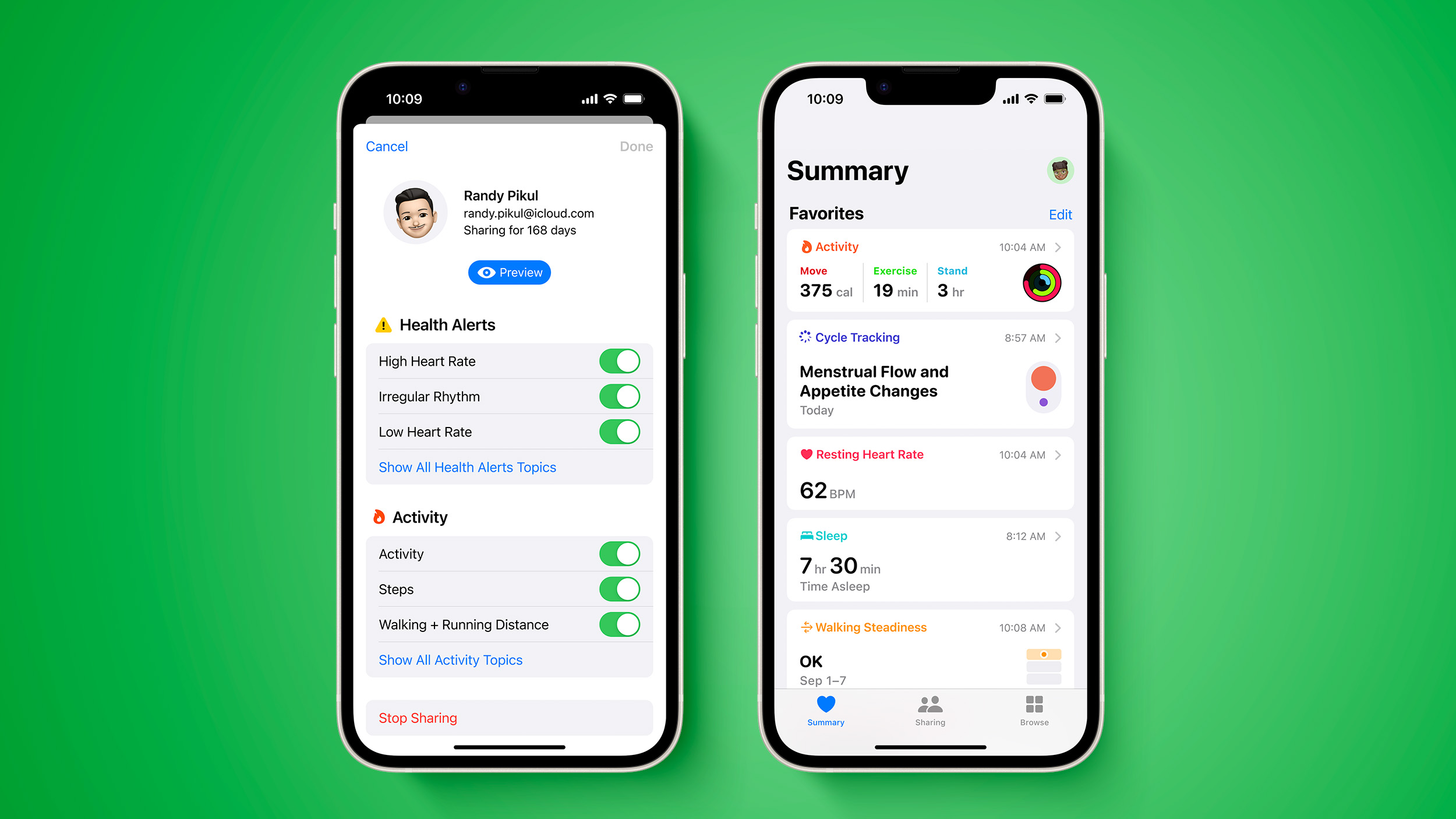


– Transparency and control: Apple says that data is only shared with explicit user permission, and the company has built clear permission prompts to give you fine-grained control over what health data you share with whom, as well as provide reminders about the data you are sharing. With HealthKit, third-party developers seeking to access your health data must provide rationale for needing that access, must include a privacy policy, and may not use your health data for advertising purposes or sell it. Any health data these apps receive via HealthKit goes directly to the apps and does not let Apple see it as an intermediary.

– Security: All health data is encrypted on device, with the exception of Medical ID data that can be displayed on your ‌iPhone‌’s Lock Screen to assist first responders and others who may need to assist you in an emergency. For users have turned on two-factor authentication and a device passcode, health data transmitted via iCloud is end-to-end encrypted, meaning that only you can decrypt it with a device that’s also logged in to your account, and Apple can’t see it unless you explicitly choose to allow it.

Apple’s new health privacy ad campaign will be running in 24 regions around the world across broadcast media, social, and billboards this summer. The company has also published a white paper with an overview of how the Health app and HealthKit protect your privacy.

This article, "Apple's Latest Ad Campaign Takes a Humorous Look at Health Data Privacy" first appeared on MacRumors.com

Discuss this article in our forums


You may also be interested in this

1TB iCloud storage plan w…

A 1TB iCloud storage plan is the missing piece in Apple's offering. Learn how this addition can meet the needs of users and Apple, too. (via Cult of Mac -

‘Sid Meier’s …

Feral Interactive recently brought the iconic game "Sid Meier's Railroads!" to iOS. It's a fun way to learn railway history, although some controls are challenging.

iMessage Contact Key Veri…

One of the first found feature changes in iOS 16.6 and iPadOS 16.6 may be an iMessage verification system that could help prevent government agencies from eavesdropping on the conversations

What’s new with Notes and…

iOS 26 Apple is revamping nearly all its native apps in iOS 26, including Notes and Reminders, with fresh features and design updates. While many changes focus on visuals, there

watchOS 10 for Apple Watc…

Apple has announced watchOS, the next major update to software. It includes comprehensive app redesigns and a new way to view information across different watch faces. Here’s what’s new. more…

Latest Hermes AirPods Pro…

Hermes revealed an expensive leather AirPods Pro 2 case and a separate lanyard that brings extreme luxury to your earbuds.Hermes Case for AirPods Pro 2Apple's AirPods Pro 2 aren't too

In case you didn’t know: …

Apple Pay has changed the game when it comes to how we buy things both in-store and online,… The post In case you didn’t know: GoodwillFinds.com accepts Apple Pay appeared

Apple issues fourth devel…

Apple has released the fourth beta version of macOS Ventura 13.4 for developers, as part of its ongoing beta cycle for hardware.New betas for macOS VenturaDevelopers who have signed up
X

A whimsical homage to the days in black and white, celebrating the magic of Mac OS. Dress up your blog with retro, chunky-grade pixellated graphics to evoke some serious computer nostalgia. Supports a custom menu, custom header image, custom background, two footer widget areas, and a full-width page template. I updated Stuart Brown's 2011 masterpiece to meet the needs of the times, made it responsive , got dark mode, custom search widget and more.You can download it from tigaman.com, where you can also find more useful code snippets and plugins to get even more out of wordpress.